About this campaign
Looks like your text is -42 character over the limit. Please shorten it to 200 characters or less.
Looks like your text is -42 character over the limit. Please shorten it to 200 characters or less.
He has turned countless bat haters into protectors by diplomatically showing them how helping bats helps people. And we work hard to help you do the same!
Merlin Tuttle?s Bat Conservation (MTBC) strives to inspire people everywhere through Merlin's one-of-a-kind experience and legacy, "win friends not battles" philosophy, captivating photos, and resources to equip YOU to be the best advocate for bat conservation you can be!
MTBC provides the world's finest bat photo gallery, and the most up-to-date responses to exaggerated disease speculation about bats. It is also the only place to access Merlin?s unique expertise at winning friends or support his work.
Pick an essential bat value or two to share with folks when they ask you about this shirt:
- From deserts of the American Southwest to the high Andes of South America and the Caribbean Islands, hundreds of species of agave and cactus plants rely on bats for pollination.
- Mexico?s entire tequila industry relies on a single species of bat-pollinated agave plant.
- Approximately 70 percent of all tropical fruits eaten by humans rely on bats as primary pollinators or seed dispersers in the wild, ranging from bananas and mangoes to peaches, cashews and dates.
There's a lot more where that came from, visit and join www.MerlinTuttle.org!
Looks like your text is -8700 character over the limit. Please shorten it to 10000 characters or less.
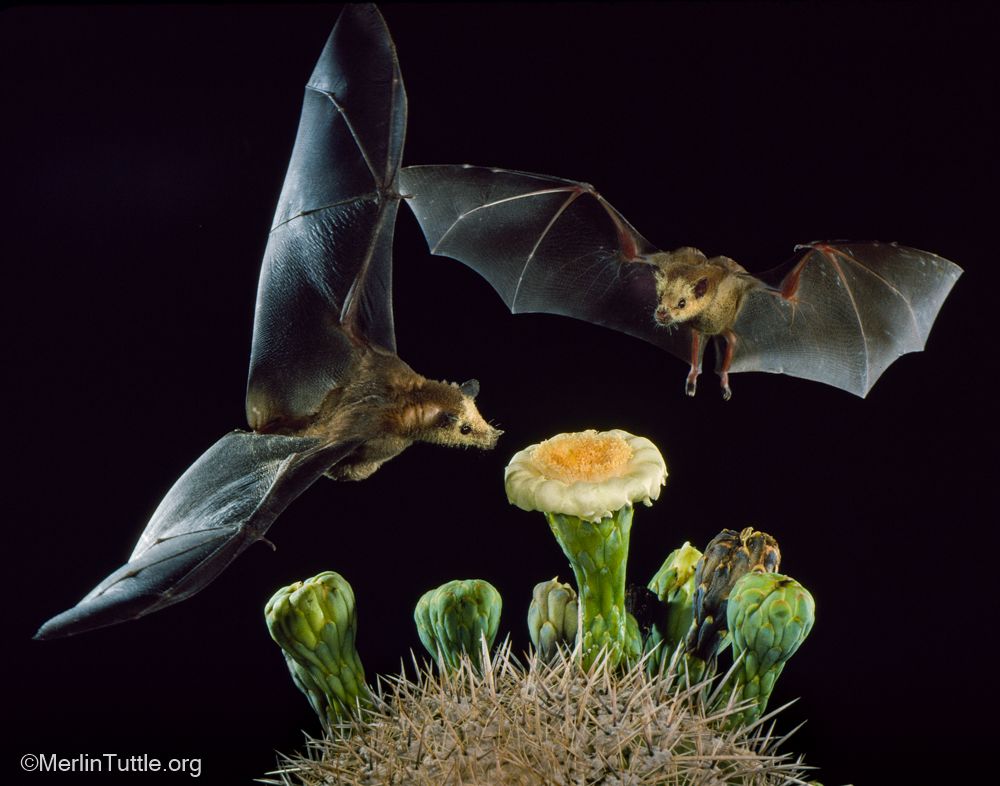
Two lesser long-nosed bats (Leptonycteris yerbabuenae) pollinating a Saguaro cactus (Carnegiea gigantea) in Mexico. The famous saguaro of the SW U.S. and Mexico opens its flowers at about midnight and is heavily reliant on bats as primary pollinators, but also is heavily pollinated by white-winged doves. Bats are its most effective long-distance seed dispersers. The large cactus provides essential food and shelter for a wide variety of desert animals.
This photo was taken on Kodachrome slide film in 1988 by Merlin Tuttle.
Looks like your text is -9472 character over the limit. Please shorten it to 10000 characters or less.